
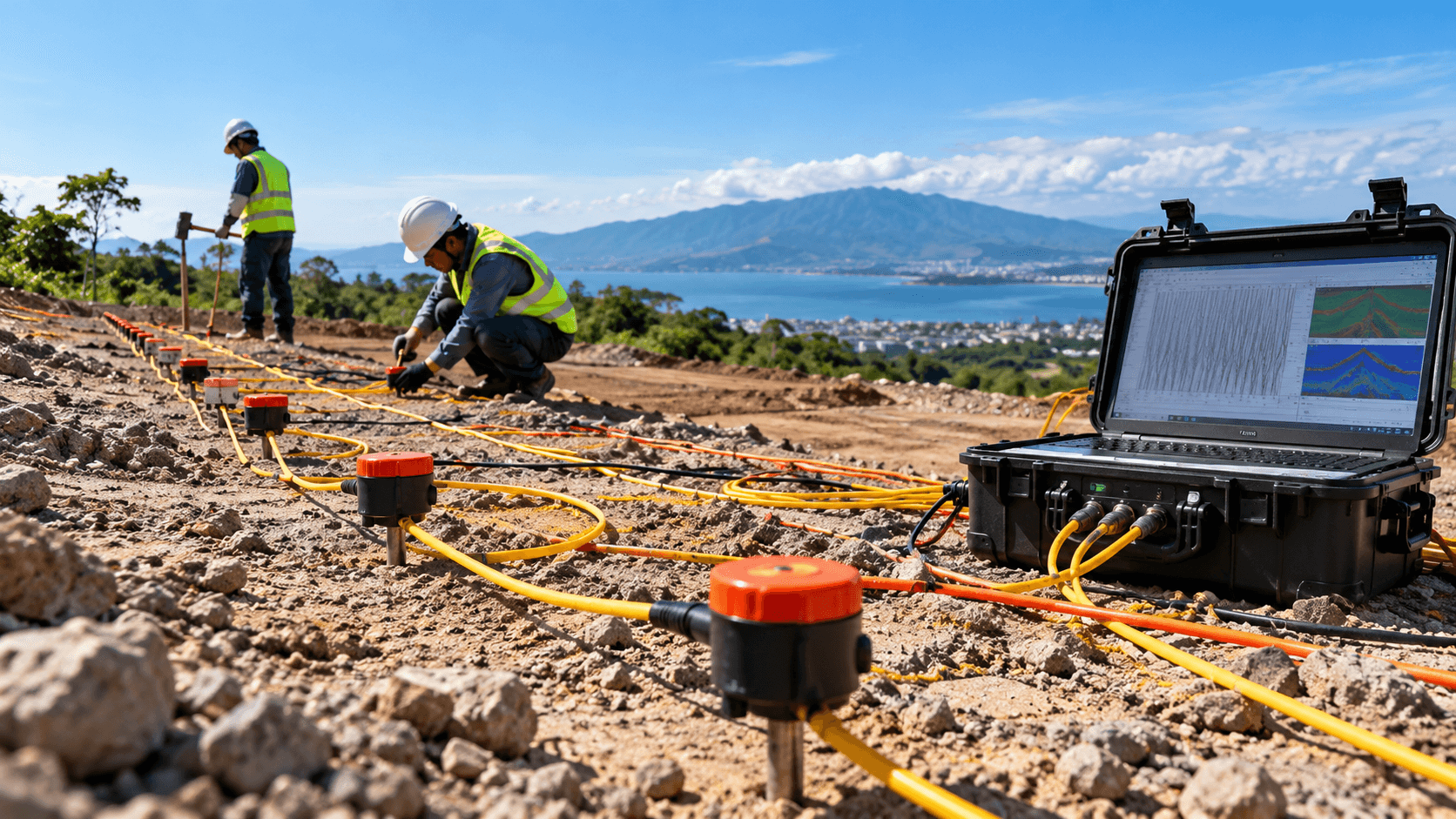
Understanding what lies beneath the ground is essential for safe and informed engineering decisions. Before constructing buildings, bridges, roads, and other infrastructure, engineers must evaluate subsurface conditions that can affect foundation design, excavation, and structural performance.
Seismic surveys provide a non-invasive or minimally invasive approach to investigating the subsurface by measuring how seismic waves travel through soil and rock materials.
In the Philippines, where geological conditions can vary considerably across project sites, geophysical investigations can provide valuable supporting information for geotechnical and engineering assessments.
What Is a Seismic Survey?
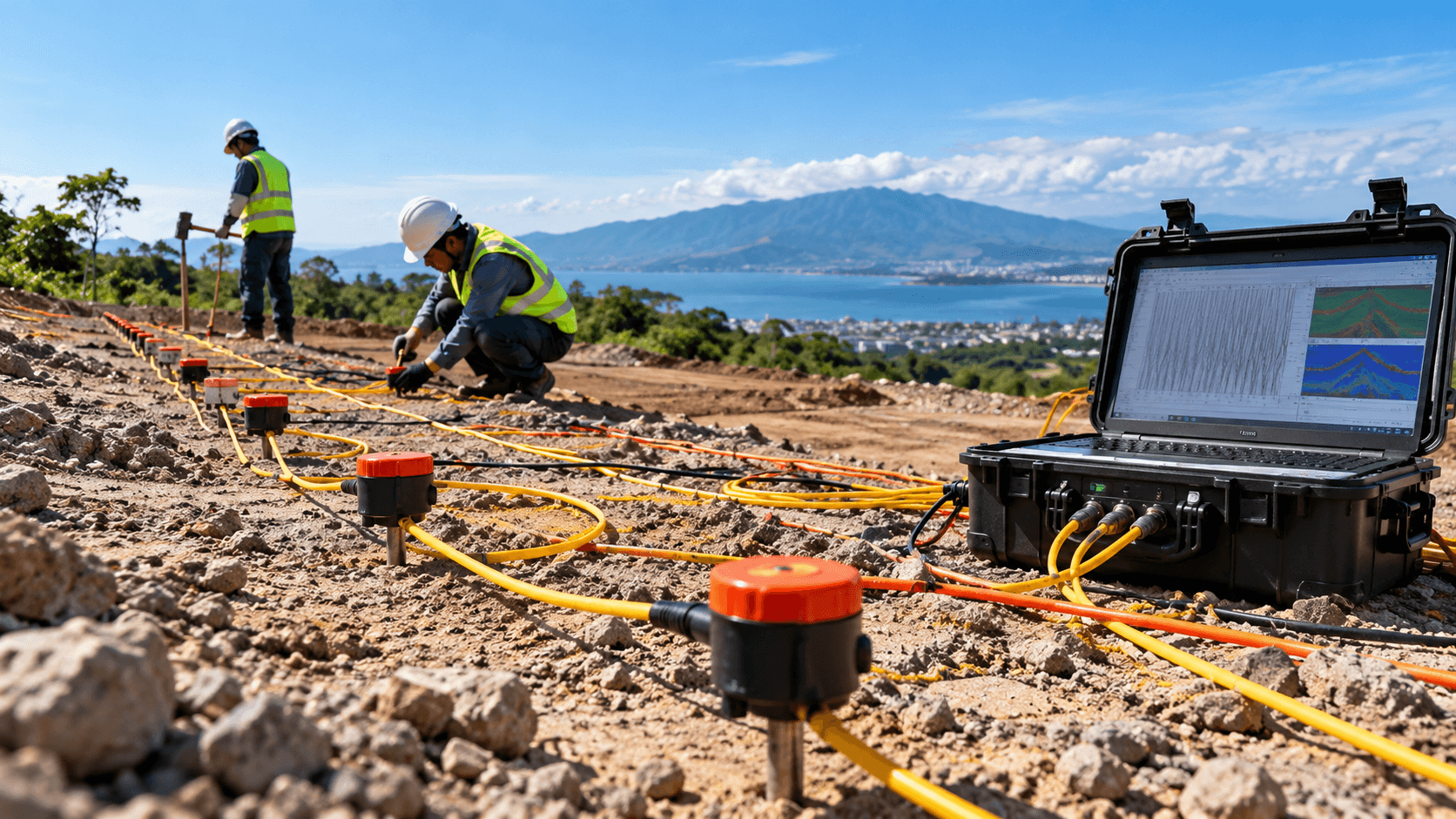
A seismic survey is a geophysical investigation that uses artificially generated seismic waves to examine subsurface materials. By recording wave travel times using specialized sensors called geophones, geophysicists can estimate seismic wave velocities and interpret variations in underground conditions.
The results help characterize subsurface layers and complement information obtained from borehole drilling, geological mapping, and laboratory testing.
Seismic Refraction Surveys
Seismic refraction is a commonly used surface geophysical method for investigating subsurface layering.
During the survey, geophones are positioned along a survey line and connected to a seismic recording system. A controlled energy source generates seismic waves, which travel through the ground and are recorded by the sensors.
Analysis of first-arrival travel times allows specialists to estimate seismic P-wave velocities and develop an interpreted subsurface velocity model.
Depending on site conditions, seismic refraction may help identify:
- Variations in subsurface seismic velocity
- Approximate depth to higher-velocity materials
- Changes in weathered and competent rock zones
- Potential excavation-related ground conditions
Interpretation requires consideration of the method's limitations, including complex geology and hidden low-velocity layers.
Downhole Seismic Testing
Downhole seismic testing measures the travel times of seismic waves between a surface energy source and receivers positioned at selected depths inside a borehole.
The method is commonly used to determine shear-wave velocity (Vs) profiles and, where measured, compressional-wave velocity (Vp) profiles.
Shear-wave velocity is particularly important in geotechnical earthquake engineering because it provides information about the dynamic stiffness of soil and rock materials.
Downhole seismic results can support seismic site characterization, including the determination of average shear-wave velocity over the upper 30 meters (Vs30), where adequate measurements and applicable procedures permit.
Why Seismic Investigations Matter
Seismic surveys provide additional subsurface information that may be useful for:
- Geotechnical site characterization
- Infrastructure and foundation planning
- Preliminary bedrock and subsurface layer assessment
- Seismic site classification
- Engineering studies involving dynamic ground properties
- Planning complementary borehole and geotechnical investigations
Seismic methods should not be treated as a replacement for borehole investigations or laboratory testing. Instead, their greatest value often comes from integrating geophysical measurements with direct subsurface observations.
GALERIO's Seismic Survey Capabilities
Galerio Environmental and Technical Services Inc. (GETSI) provides specialized geophysical investigation services, including seismic refraction and downhole seismic testing, as part of its broader environmental, geological, geotechnical, and engineering capabilities.
Through the integration of field measurements and technical interpretation, GALERIO supports project teams requiring subsurface information for engineering assessments and infrastructure development.
For project-specific seismic survey requirements, clients may coordinate with GALERIO to discuss site conditions, investigation objectives, proposed survey methods, and technical scope.
For inquiries: Contact GALERIO through the website's Contact Us section.
References & sources
- GALERIO